

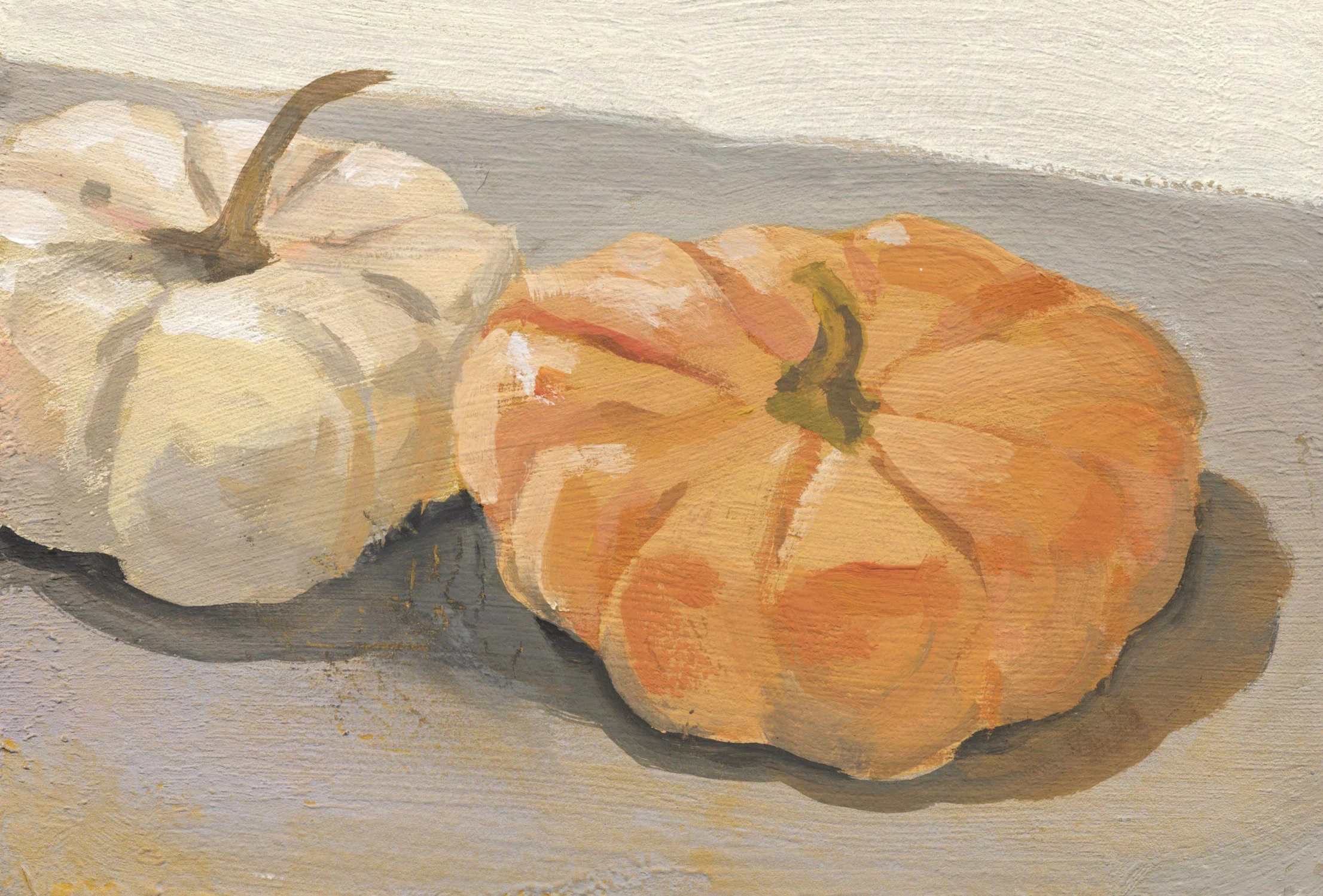
“Two Gourds” - 5”x7”, Casein On Gessoed Paper
Although I’m known for watercolor paintings, I enjoy working in other media as well. That includes various drawing media as well as three other water-based media. The one that has become my favorite alternative to watercolor is casein.
Casein is a new-old media. It’s one of the oldest painting media, even pre-dating another secondary but more well-known media, egg tempera. It has working character similar to gouache and acrylic but with a finish quality different from both. It was a popular media with illustrators in the early and mid-twentieth century, but gradually lost its place in artists studios to acrylic paint which began to fill the niche for a versatile, fast-drying opaque painting media in the 1960’s.
“Paint” is basically a combination of two ingredients: pigment and binder. These two ingredients are ground or mulled together into what is essentially a thick paste. Other ingredients may be added to enhance or improve working character, but it is really only these two that make ‘paint’. The pigment determines the color, the binder ensures that the pigment will stick, or bind, to the painting surface. Separate mediums use separate binders; oil for oil paint, gum arabic for watercolor, and polymer (plastic) for acrylic. The binder for Casein is milk protein. This explains its long history since animal milk has been used and consumed by humans for millennia and was employed for various purposes long before other binders were even discovered.
After being pushed aside in favor of acrylic, casein was a bit forgotten for quite a while. It has made a resurgence in the past decade or so and is again being appreciated for its unique and versatile working character.
I’ve found it to be an interesting media that can produce a look similar to oil paint but with the ability to produce interesting effects when used semi-transparently.
Personally, I like it for smaller works that let me create intimate views of common objects in high-key compositions.
One of the downsides to casein is a tendency to develop cracks on the surface. It’s best to paint on a stiffer surface to avoid this problem. I’ve found 300lb watercolor paper to be a great surface with built in texture. Rather than paint casein over new watercolor paper, I like to use watercolor paper that has been renewed by the process described here.
This painting is one of those. These two little gourds are left over Halloween decorations that I brought into the studio and set up next to one of my easels so I could make a small study.
As mentioned, I like to use casein for light valued subjects and to make use of its semi-transparent state to create light and color effects. For this subject, I was able to get interesting bounced light effects by layering more transparent strokes over opaque passages.
Although mostly an opaque media, when used mostly in light values, I find that casein paintings have an airiness that mimics some of the visual effect of transparent watercolor.
Casein is not likely to replace watercolor as my main medium, but does serve as an interesting alternative for certain subjects and desired color and light effects.